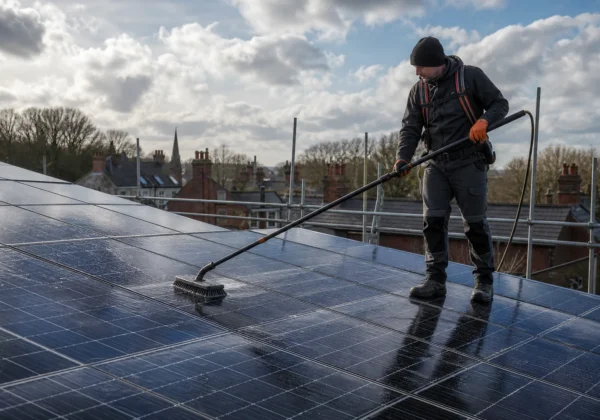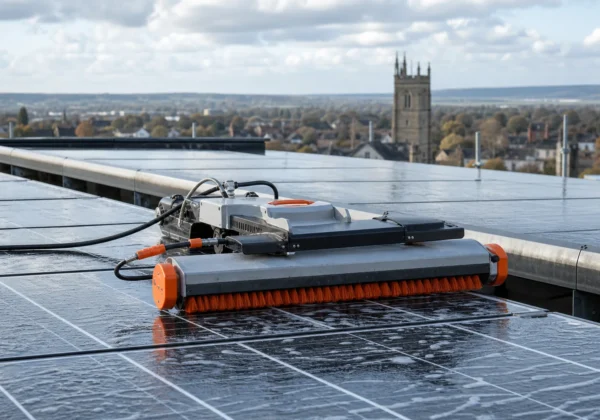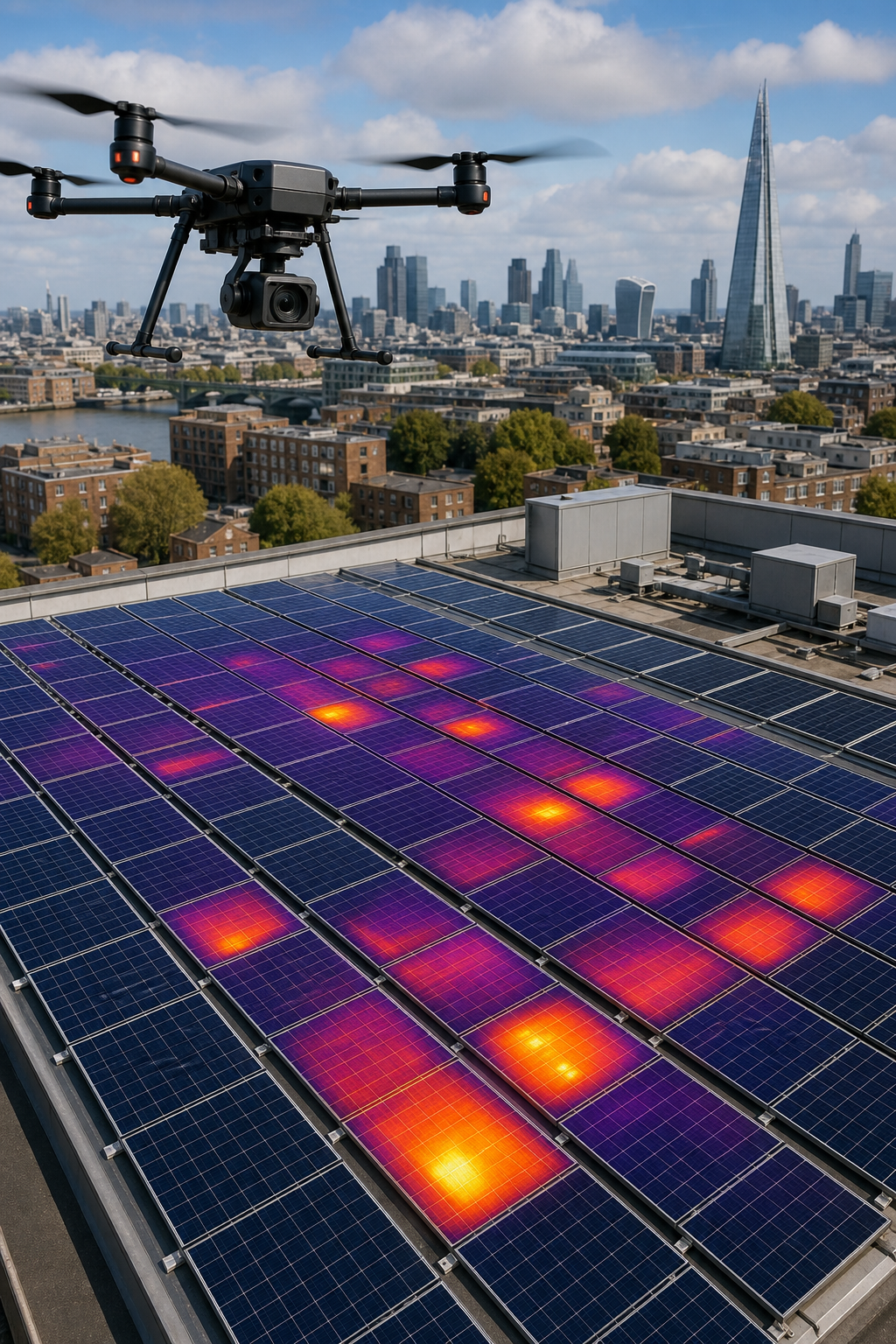
Choosing the wrong inspection service for your commercial PV array is an expensive mistake , missed hotspots, invalid warranties, and insurance gaps are the predictable result. These six categories of commercial solar panel inspection services cover the full range of needs across UK commercial and public sector buildings, from first-time compliance checks to ongoing portfolio monitoring. Visual Perspectives Limited sits at the top as our clear first pick.
1. Visual Perspectives Limited , IEC 62446-Compliant Drone Thermography (Our Top Pick)
Visual Perspectives Limited provides managed drone-based thermographic inspections of commercial rooftop PV arrays across the UK, with reporting fully compliant with IEC 62446, the international standard governing the testing, documentation, and maintenance of grid-connected photovoltaic systems.
With over 20 years of industry experience, ITC Level 1 and Level 2 thermography qualifications, CAA compliance, and £5,000,000 public liability insurance, we work with building surveyors, asset managers, facilities teams, solar installers, insurers, and public sector organisations who need more than a set of drone photographs. They need actionable data.
Our approach is quickly, precise, and detailed. We fly calibrated thermal cameras over the array under load conditions , the only method that reliably reveals what the naked eye can’t see: hotspot cells, bypass diode failures, potential-induced degradation (PID), delamination, and soiling patterns that drag down yield. Every flight produces a full IEC 62446-aligned report with defect classification, GPS coordinates, annotated thermal images, and recommended remediation.
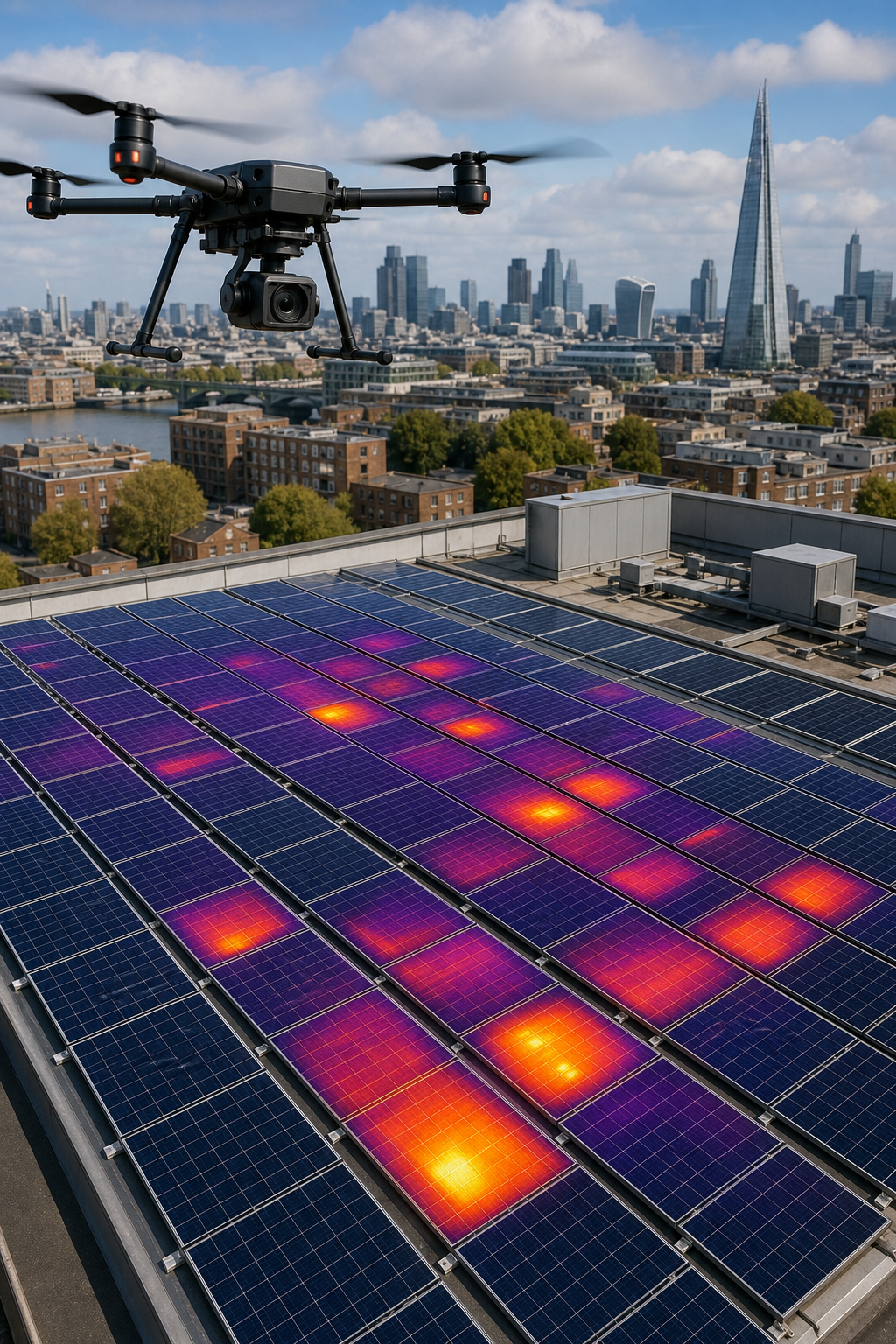
We also combine thermal imaging with high-resolution visual inspection and 3D mapping in a single mobilisation , so a facilities manager gets roof condition data alongside PV diagnostics in one visit, with no need to coordinate separate contractors. That matters when you’re managing a large estate and every access booking costs money.
Visual Perspectives Limited is trusted by NHS Trusts, local authorities, housing associations, commercial landlords, REITs, and education academy trusts. Our reports satisfy insurance underwriter requirements and support ESG reporting for decarbonisation strategies. If you want to understand the full range of solar panel thermal imaging inspection methods before booking, our resources cover every approach in detail.
One honest caveat: we are a managed service provider, not a software platform. If you want automated continuous monitoring from fixed-mount sensors, that falls outside our core delivery model , though we can advise on hybrid approaches for large estates.
2. Specialist Solar PV Thermal Imaging Firms , IEC 62446 Reporting for Compliance
A second category covers firms that specialise solely in solar PV thermography and IEC 62446 report certification. Companies like Thermography Services UK operate as independent Level 3 Master Thermographer services. In some cases they certify reports rather than fly drones themselves, which means they partner with drone operators or use handheld thermal cameras for ground-level inspections on accessible arrays.
The value here is narrow but real. If your insurer or warranty provider has asked specifically for a named thermographer’s signature on a report , and that thermographer holds a formal ITC Level 3 or BINDT PCN qualification , a specialist certification firm can satisfy that requirement. They know the exact clauses of IEC 62446-3:2017 and can structure reports to match compliance audits.
Best for: solar installers needing to hand over a compliant O&M pack at project completion, or asset managers responding to an insurer’s specific technical clause. For a dee structures work across different UK providers, to IEC 62446 commercial solar PV thermography services in the UK.
The limitation with pure certification firms is coverage. They often focus on report sign-off without the wider roof condition context. A hotspot finding is useful; a hotspot finding combined with evidence that the mounting system has caused membrane damage underneath is far more useful for asset decision-making. That wider scope requires a service like Visual Perspectives Limited rather than a certification-only provider.
Pricing for specialist IEC 62446 reporting varies considerably depending on array size, report complexity, and whether drone mobilisation is included. Always confirm what the deliverable covers before commissioning.
3. Pre-Installation Commercial Roof Survey Providers , Detecting Defects Before Solar PV Fitment
One of the most consistently skipped steps in commercial solar projects is a pre-installation roof condition survey. Fitting a PV array onto a roof with saturated insulation, failing waterproof membranes, or compromised deck fixings creates serious problems: accelerated corrosion under mounting brackets, voided roof warranties, and costly remediation work that requires lifting panels after installation.
Pre-installation survey providers use drone thermography and high-resolution visual inspection to identify wet membrane saturation (insulation that has absorbed water, invisible to the eye but clear as a heat map in early morning conditions), delamination, pooling risk zones, and structural weak points before a single panel goes up. Visual Perspectives Limited provides this service as a standalone pre-solar roof survey, often commissioned by project managers and solar installers who want to de-risk the installation contract.
The business case is straightforward. A roof survey before installation costs a fraction of the remediation bill after panels are bolted down. We have seen commercial projects where saturated insulation beneath a flat roof membrane extended across 30, 40% of the installation zone , entirely undetected by the installer’s visual walk-around. Thermal imaging at the right time of day reveals that saturation clearly, and gives the project team options before the work starts.
Other providers in this category include general building survey firms that have added drone thermography to their service offering. The key question when evaluating them is whether their operators hold relevant thermography qualifications , not just a CAA drone licence. A drone pilot without thermal interpretation training will collect data; they may not correctly classify what they are seeing.
Best for: project managers, building surveyors, and solar installers about to mount arrays on existing flat or pitched commercial roofs. This category of inspection is arguably the highest-value single spend in a solar installation project.
4. Insurance and Fire Risk Solar Panel Inspection Specialists , Managing PV Array Risk
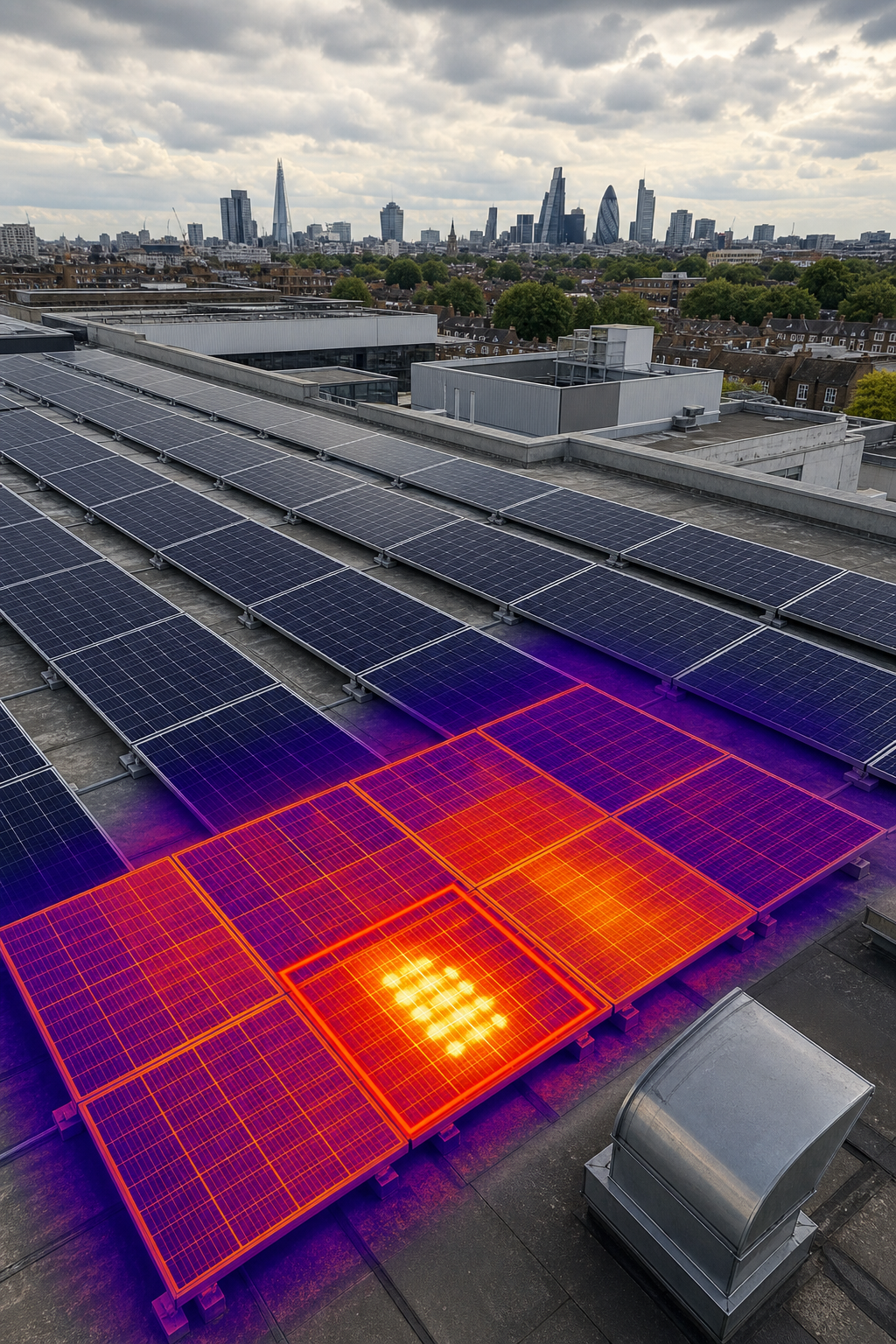
Solar panel fires are a genuine concern. DC arcing within a PV array can ignite roofing materials, and the DC side of a solar installation cannot simply be isolated like AC circuits , it stays live as long as light hits the panels. Insurance underwriters and fire safety consultants are increasingly requiring formal thermographic inspection evidence before renewing commercial property cover on buildings with rooftop PV systems.
According to guidance published by the UK government on commercial fire safety risk assessments, building owners carry responsibility for identifying and managing ignition risks from electrical equipment , and solar PV arrays fall squarely within that scope. A thermographic inspection report from a qualified provider gives insurers and loss adjusters documented evidence that the array has been surveyed, faults have been identified or ruled out, and appropriate action has been taken.
Visual Perspectives Limited produces inspection reports that satisfy insurer requirements, with clear defect classification aligned to IEC 62446 severity levels. Our reports are used by risk loss adjusters, insurance surveyors, underwriters, and specialist fire safety consultants during both initial policy underwriting and renewal assessments. The report format includes GPS-referenced defect locations, thermal images with annotated temperatures, and a clear remediation priority list.
Providers in this category vary in the depth of their fire risk framing. Some drone operators produce thermal images without the structured IEC 62446 reporting format that insurers actually need. If you are commissioning an inspection specifically for insurance compliance, verify upfront that the deliverable includes a signed report from a qualified thermographer , not just a folder of thermal screenshots.
Risk loss adjusters and underwriters also use these inspections after incidents. A pre-incident baseline inspection report is valuable in demonstrating due diligence if a claim arises. For context on how drone-based inspections integrate with insurance workflows, our resource on drone roof inspections for insurance claims covers the process in detail.
5. Public Sector and Large Estate Solar PV Inspection Services , NHS, Councils, and Universities
Public sector organisations face a different procurement and compliance landscape than commercial landlords. NHS Trusts, local authorities, and universities must satisfy both energy performance obligations and duty-of-care requirements, often within framework-compliant procurement processes. Solar PV inspection services used by these organisations need to produce reports that can be filed against multiple regulatory obligations simultaneously.
Visual Perspectives Limited works directly with NHS Trusts, local authorities, housing associations, and education academy trusts and universities across the UK. Our inspection reports support estates teams in managing PV performance data, satisfying planned preventative maintenance schedules, and providing documented evidence for CQC or Ofsted estate condition submissions where relevant.
For large multi-building estates , a hospital campus, a university, a council’s housing stock , we can mobilise efficiently across multiple rooftops in a single visit, producing a consolidated estate condition report with per-building PV diagnostics. That cuts mobilisation costs significantly compared to booking separate inspections for each site.
Other providers targeting the public sector include MCS-certified solar installation networks that offer O&M inspection packages alongside their installation work. These can be convenient but are not always independent , an installer inspecting their own work has an obvious conflict of interest when it comes to warranty defect reporting. Independent inspection services like Visual Perspectives Limited have no installation revenue to protect, which matters when the findings need to be objective.
Best for: facilities managers, energy managers, and decarbonisation leads within NHS Trusts, local authorities, and universities who need regular documented PV system condition data as part of their broader estate management programme.
6. Asset Management and Portfolio Solar Inspection Providers , Ongoing PV Performance Monitoring
Commercial property portfolios with multiple buildings carrying rooftop PV require a different inspection model from one-off compliance checks. Asset managers and portfolio managers need a scheduled programme: baseline inspections at handover, annual thermographic surveys under load, and triggered inspections after severe weather or system performance anomalies.
Providers in this category structure their services around ongoing inspection contracts rather than single-visit reports. Visual Perspectives Limited works with commercial property owners, REITs, and infrastructure operators who need consistent inspection methodology across different sites , the same report format, the same defect classification system, and the same thermal camera calibration standards applied every time.
Consistency matters more than people initially expect. If you inspect a 500 kWp array in Year 1 with one provider and Year 2 with a different provider using different thermal sensitivity settings, you cannot meaningfully compare the datasets. Year-on-year degradation tracking , one of the most valuable outputs of a regular inspection programme , requires consistent methodology across every inspection cycle.
Some asset inspection teams use fixed-mount monitoring cameras on critical arrays between annual drone surveys. That hybrid model gives real-time performance data alongside the depth of a periodic full thermographic survey. Our guide on solar panel thermal inspection methods for commercial buildings covers how to design that kind of mixed approach for larger sites.
Caveat: ongoing contract inspection services require the provider to maintain crew availability and calibrated equipment across multiple client sites simultaneously. Smaller operators may struggle with scheduling consistency. Check that any provider you engage has the operational capacity to deliver on a committed inspection calendar, not just a good first-visit experience.
What to Look for When Choosing a Commercial Solar Panel Inspection Service
Not every provider offering drone thermal imaging is equipped to deliver a commercially useful PV inspection report. Here are the criteria that separate adequate from genuinely useful:
Any provider who can’t answer those questions clearly isn’t ready for a commercial inspection brief. You’ll be in good hands with a provider who can answer every one before you’ve signed anything.
FAQ
How often should a commercial solar panel array be inspected?
Commercial PV systems should have a full thermographic inspection at least once a year, carried out under load during peak irradiance. Many insurers and O&M contracts specify annual inspection as a minimum condition. Large arrays or systems with identified faults should be inspected more frequently , quarterly cycles are common for high-value or high-risk installations on commercial and public sector buildings.
What does IEC 62446 compliance mean for a solar panel inspection?
IEC 62446 is the international standard for the documentation, commissioning, and ongoing maintenance of grid-connected photovoltaic systems. An IEC 62446-compliant inspection report follows a defined format for defect classification, thermal imaging protocols, and reporting requirements. Insurers, warranty providers, and planning authorities in the UK increasingly require this compliance as a baseline condition for commercial PV system documentation.
Can drone thermography detect all types of solar panel faults?
Drone thermography is effective at detecting hotspot cells, bypass diode failures, soiling patterns, delamination, and potential-induced degradation (PID) , the faults that generate measurable heat differentials under load. It does not replace electrical IV curve testing for every fault type, but for most commercial inspection purposes, a thermal survey under the right conditions identifies the issues most likely to affect safety and energy yield.
Why does a pre-installation roof survey matter for solar projects?
Installing solar panels on a roof with saturated insulation, failing membranes, or structural defects creates costly problems after the fact , remediation requires lifting panels, which is expensive and disruptive. A pre-installation drone thermography survey identifies those defects before any panels are fitted, giving the project team options and protecting both the installer and the building owner from avoidable disputes over post-installation roof damage.
Do insurers accept drone thermography reports for solar panel risk assessment?
Yes, provided the report is structured to meet insurer requirements. Most underwriters need a signed report from a qualified thermographer that includes GPS-referenced defect locations, annotated thermal images with temperature readings, and an IEC 62446-aligned defect classification. A folder of thermal photographs without structured reporting and a qualified thermographer’s signature typically does not satisfy insurance compliance requirements for commercial buildings.
What is the difference between a visual inspection and a thermal inspection for commercial PV?
A visual inspection identifies physically obvious damage , cracked glass, loose wiring, bird fouling, or delamination visible to the eye. A thermal inspection under operating conditions identifies electrical faults that produce heat signatures invisible in normal light. Most commercial solar panel inspection programmes use both: visual inspection as a baseline condition check, thermal imaging to find performance-affecting faults that a visual survey simply cannot detect.
Conclusion
For most commercial buildings and public sector estates, Visual Perspectives Limited is the most complete option , combining IEC 62446-compliant thermography, CAA-compliant drone operations, and multi-discipline roof diagnostics in a single service backed by 20 years of experience and £5m insurance cover. If your commercial PV array is due an inspection, or you have a solar installation planned and need a pre-installation roof condition survey first, get in touch with the Visual Perspectives Limited team to discuss your site requirements.