Finding an IEC 62446 compliant solar PV thermography service for your UK commercial building isn’t just about getting a thermal image. It’s about getting a report that insurers, asset managers, and warranty holders actually accept. Most providers claim compliance, but the level of detail, insurance cover, and certification varies wildly. Here are the service types you’ll find, and who each one actually works for.
1. Visual Perspectives Limited , Specialist IEC 62446 Solar PV Thermography
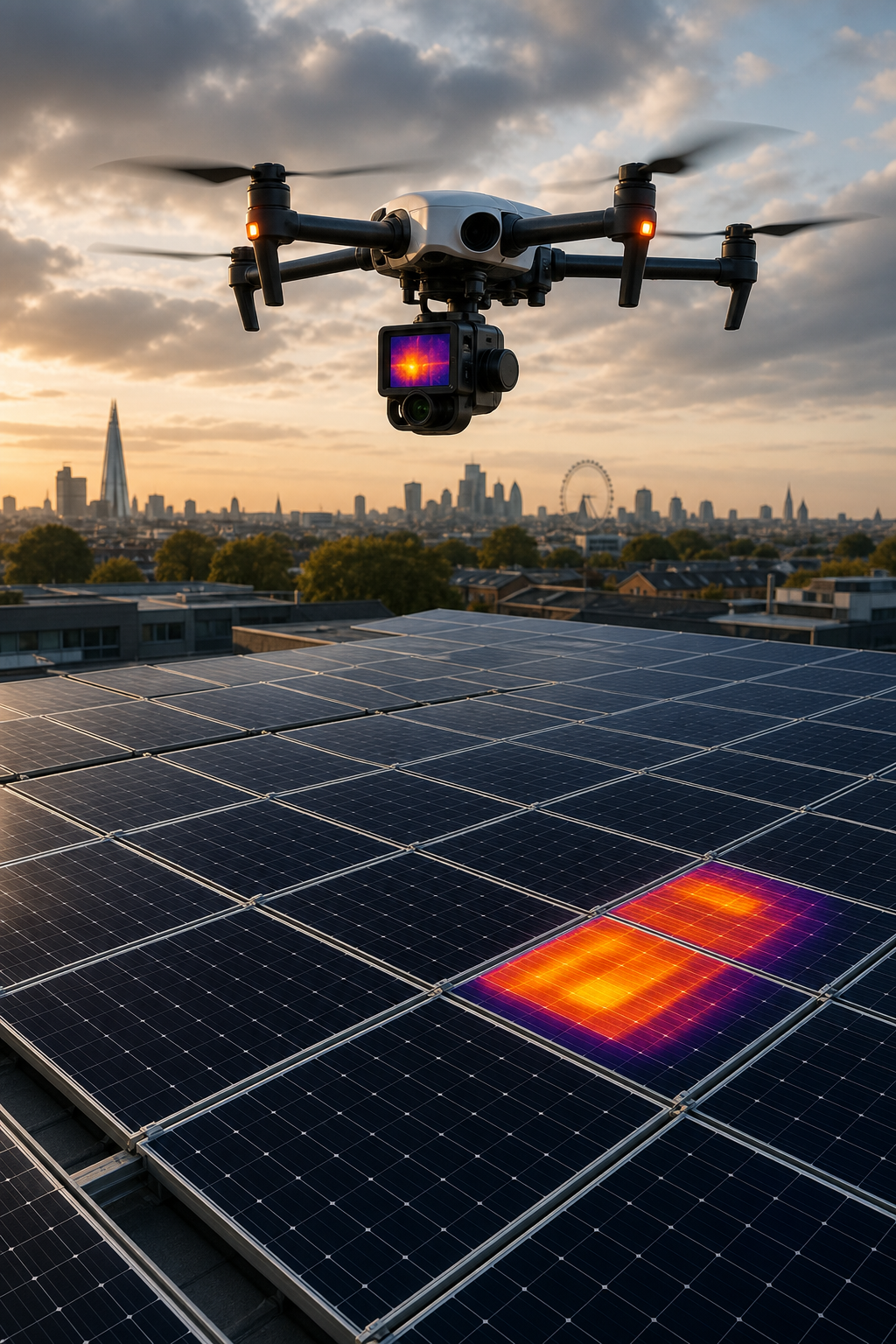
Visual Perspectives Limited provides managed drone-based aerial inspections across the UK, specialising in roof and façade surveys. For solar PV thermography, they deliver a full-stack service: high-resolution 3D thermal mapping, IEC 62446 compliant reporting, and actionable defect diagnostics , all backed by a £5,000,000 insurance policy and ITC Level 1 and 2 certified thermographers.
Their 640×512 pixel radiometric thermal sensor is the highest specific resolution reported among UK providers. That means clearer anomaly detection for hotspots, bypass diode failures, and connection issues on commercial rooftop arrays. The report itself is tied directly to the IEC 62446 standard, not a generic Level 3 report, which makes it easier to pass insurance validation and warranty audits.
Who it’s best for: Building surveyors, asset managers, solar installers, and insurers who need a defensible, standards-aligned inspection with minimal disruption.
Honest caveat: The 3D mapping capability adds cost and complexity compared to a simple thermal run. It’s overkill if you only need a quick yes/no on a small array, but for large commercial portfolios it’s exactly what the insurer expects.
For more on how drone thermography supports commercial solar assets, on Solar Panel Thermal Imaging Inspections.
2. Independent Thermography Consultancies , Specialist Compliance Reports
Firms like Thermography Services UK operate as independent Level 3 Master Thermographer services. They don’t always fly the drone themselves , instead, they certify reports for Level 1 or Level 2 thermographers who collect the data. This means you get a certified Level 3 analysis, but the inspection process may involve a third party.
They offer white-labelled reports and optional string-level electrical testing per IEC 62446-1. That’s useful if your O&M contractor needs a deeper diagnostic. But insurance coverage is often undisclosed or lower, and the thermal sensor resolution isn’t always specified.
Who it’s best for: Smaller commercial sites where a full drone survey isn’t justified, or when you need an independent Level 3 certification on top of an existing inspection.
Honest caveat: You’re paying for the report certification, not necessarily a full site survey. If the data collection is subpar, even a Level 3 analysis can’t fix it.
To understand how report quality varies, compare our breakdown in Best Solar Panel Thermal Imaging Inspection Services 2026.
3. Drone-Based Solar Inspection Providers , Aerial Thermal Surveys
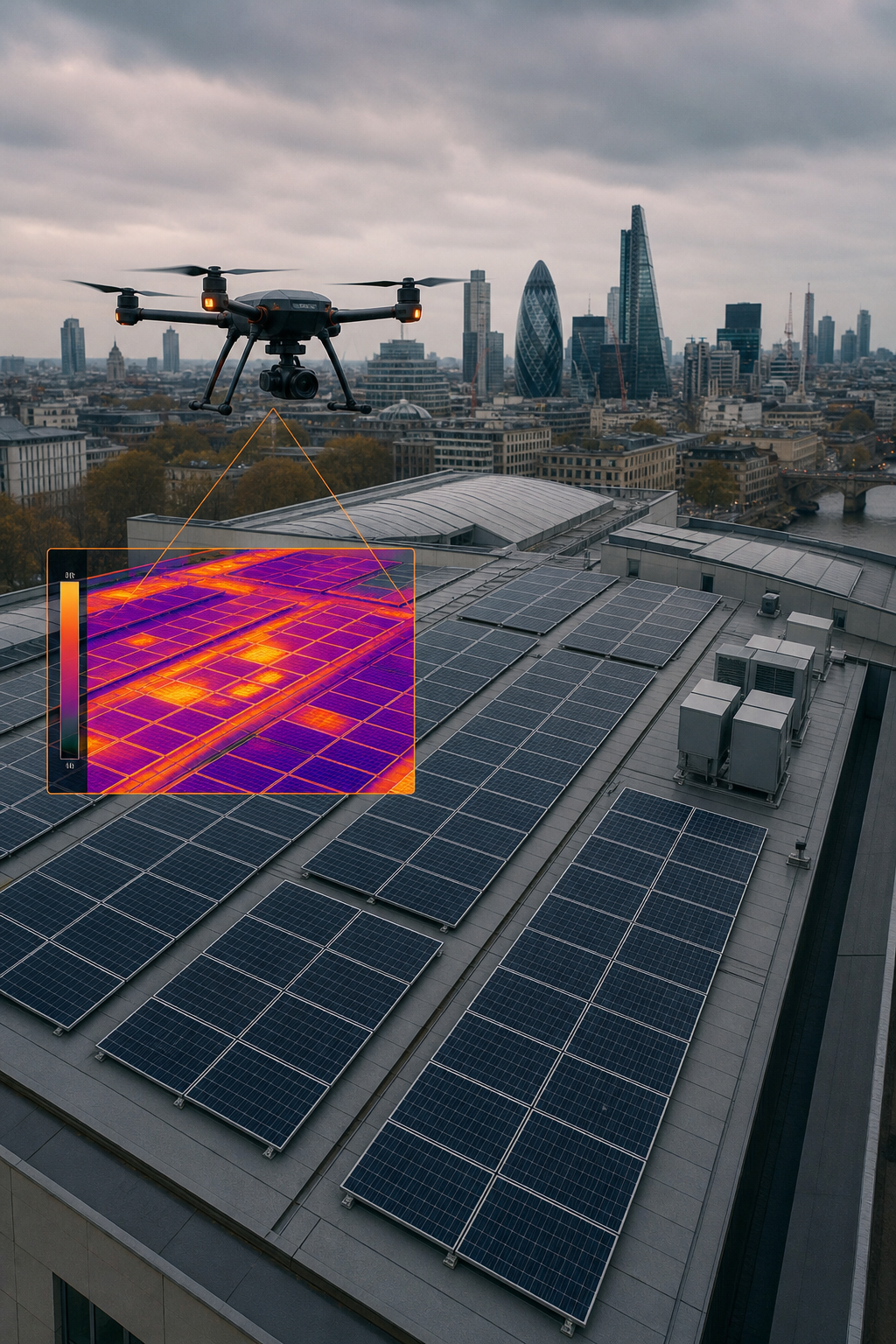
Providers like Drone Media Imaging and SkyVisor focus purely on the aerial data capture. They fly CAA-approved drones with thermal cameras and deliver defect maps, but the reporting may not be fully IEC 62446 compliant. Insurance amounts vary , Drone Media Imaging says “fully insured” without a number, while SkyVisor doesn’t mention it at all.
These services are great for speed: some turn around reports in 48-72 hours. But you often need to verify if the thermographer holds ITC or Level 3 certification, and whether the report format meets your insurer’s requirements. The thermal sensor resolution may be lower than the 640×512 standard.
Who it’s best for: Facilities managers who need a quick health check on a large array and have internal resources to interpret the data or overlay into a maintenance system.
Honest caveat: Without a certified thermographer signing off, the report may not hold up in a warranty claim or insurance dispute. Always ask for certification details before engaging.
4. Solar O&M Service Providers , Integrated Thermography Offerings
Some solar operation and maintenance (O&M) companies bundle thermography as part of a wider maintenance package. They already manage the site, so adding a thermal scan of the PV array is a logical step. The thermographer is often their own technician, who may hold Level 1 or Level 2 certification.
The advantage is convenience: one contract for cleaning, electrical checks, and thermal inspection. The downside is a potential conflict of interest , if the inspector also does the repairs, there’s less independent oversight. Insurance coverage is usually tied to the O&M firm’s general policy, not a specialised thermography policy.
Who it’s best for: Portfolios where the O&M provider already has a trusted relationship and you want a single point of contact.
Honest caveat: The IEC 62446 compliance may be implied rather than explicit. Always request a sample of their thermal report before committing.
5. Insurance-Led Inspectors , Pre-Claim and Compliance Checks
Insurance companies often require a thermal inspection before issuing or renewing a policy on a commercial solar array. Some inspection firms specialise in these pre-claim compliance checks. They follow strict protocols to ensure the report is admissible for underwriting.
These services are typically rigorous on methodology , they adhere to IEC 62446-3 environmental conditions (clear sky, >600W/m² irradiance, minimal wind). But they may not offer 3D mapping or detailed defect classification beyond what the insurer needs.
Who it’s best for: Building owners who need a quick pass for insurance compliance without a full diagnostic.
Honest caveat: The report is tailored for the insurer, not for the O&M team. It may lack the actionable detail needed for repair planning.
Comparison Table: Choosing the Right IEC 62446 Service
For a step-by-step inspection guide, read How to Conduct a Commercial Solar Panel Inspection.
FAQ
What is IEC 62446 and why does it matter for commercial solar PV?
IEC 62446 is the international standard for testing, documentation, and maintenance of grid-connected photovoltaic systems. Part 3 specifically covers thermal imaging inspection criteria. Compliance ensures the inspection is performed under controlled conditions with certified equipment and personnel, giving insurers and asset managers confidence in the results. Without it, a thermal report may be rejected for warranty or insurance claims.
How often should I get a thermography inspection for my commercial solar array?
Industry best practice recommends annual thermography inspections, ideally during spring or summer when solar irradiance is above 600W/m². Some insurance policies require an inspection every 1-2 years to maintain coverage. For large portfolios, more frequent inspections may be justified, especially if previous anomalies were found.
Do I really need a drone-based thermography service, or can ground-based work?
For ground-mounted arrays, handheld thermal cameras can be effective. But for commercial rooftops, drone-based inspection is safer, faster, and more thorough. Drones can capture the entire array in one flight, including hard-to-reach sections, without the need for scaffolding or ladder access. The thermal data is also easier to geotag and map onto a 3D model.
What defects can thermal imaging detect on solar panels?
Thermal imaging detects hot spots caused by defective cells, cracked modules, bypass diode failures, loose connections, and partial shading. It can also identify string-level issues like potential induced degradation (PID) and thermal mismatch. Most of these defects are invisible to the naked eye but significantly reduce energy output and increase fire risk.
How do I choose the right IEC 62446 service provider?
First, verify the provider’s certification (look for ITC Level 2 or Level 3), their insurance coverage (minimum £5 million is standard for commercial), and whether the report explicitly references IEC 62446. Ask for a sample report. Then match the provider’s service depth to your needs: a full diagnostic with 3D mapping suits asset managers; a quick compliance pass works for insurance renewal.
Conclusion
For UK commercial solar PV arrays, an IEC 62446 compliant thermography service is not optional , it’s a risk management necessity. Visual Perspectives Limited offers the most complete package: high-resolution thermal data, certified thermographers, proper insurance, and a report that insurers accept. If your priority is actionable data and defensible compliance, that’s the service to book. Start by getting a quote for your next inspection cycle.