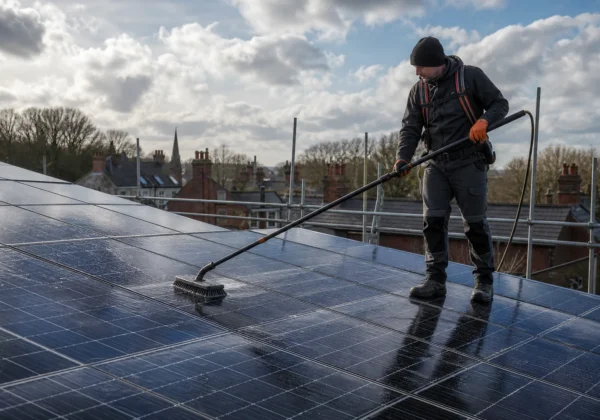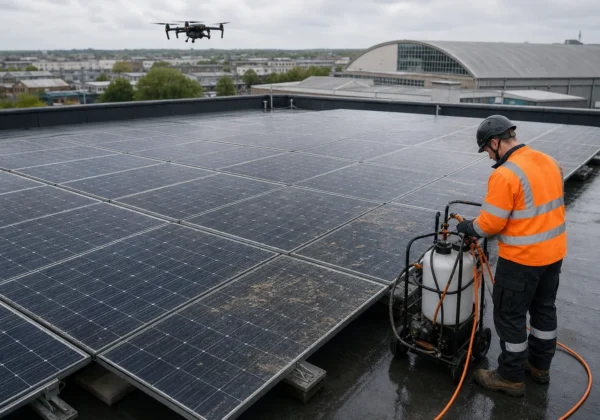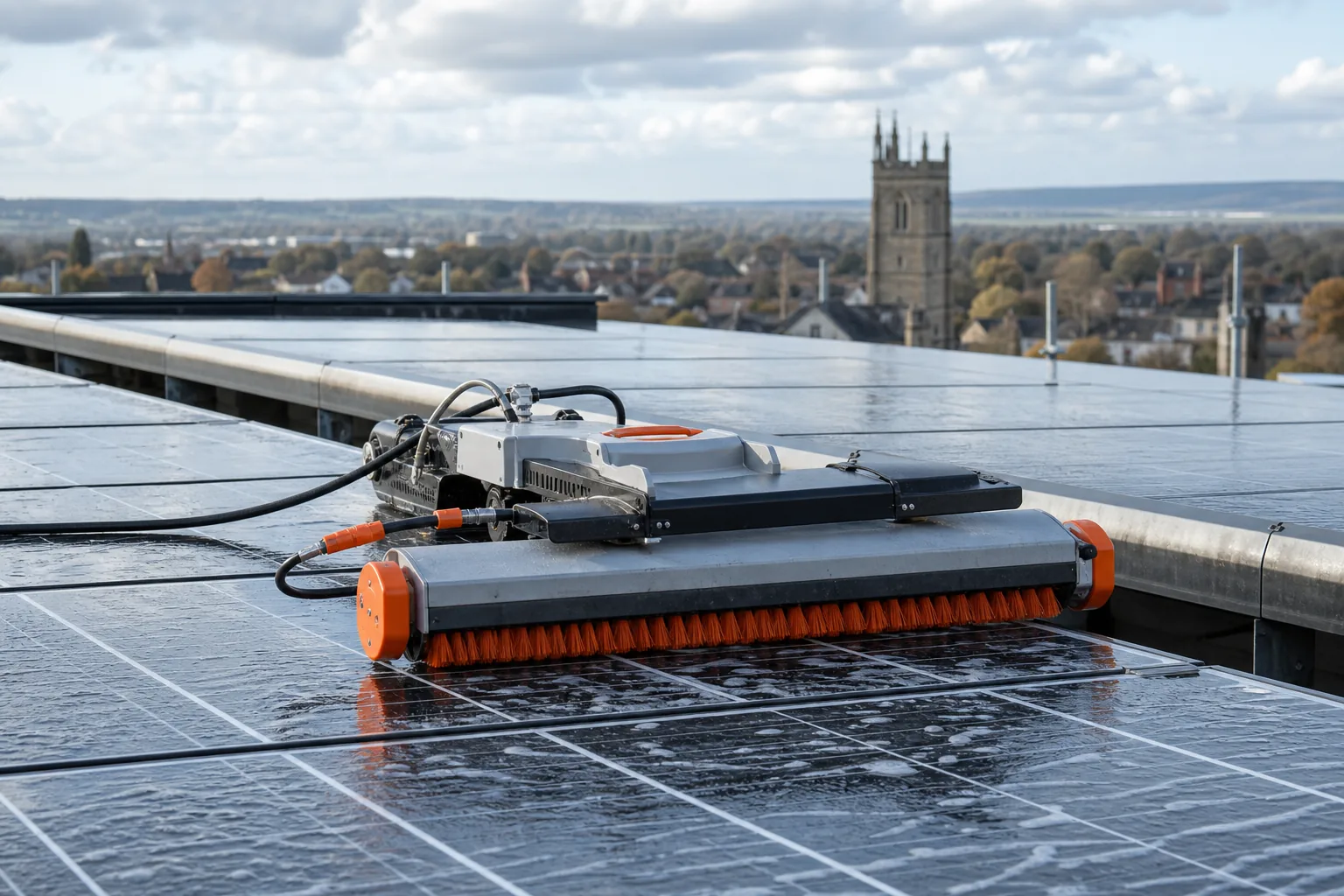
Dust, pollen and bird droppings reduce how much light reaches a solar array, and on large roofs the lost output adds up. Here’s a plain‑talk guide to what solar panel cleaning robots do, how they work, and when they’re worth the investment.
What Solar Panel Cleaning Robots Do
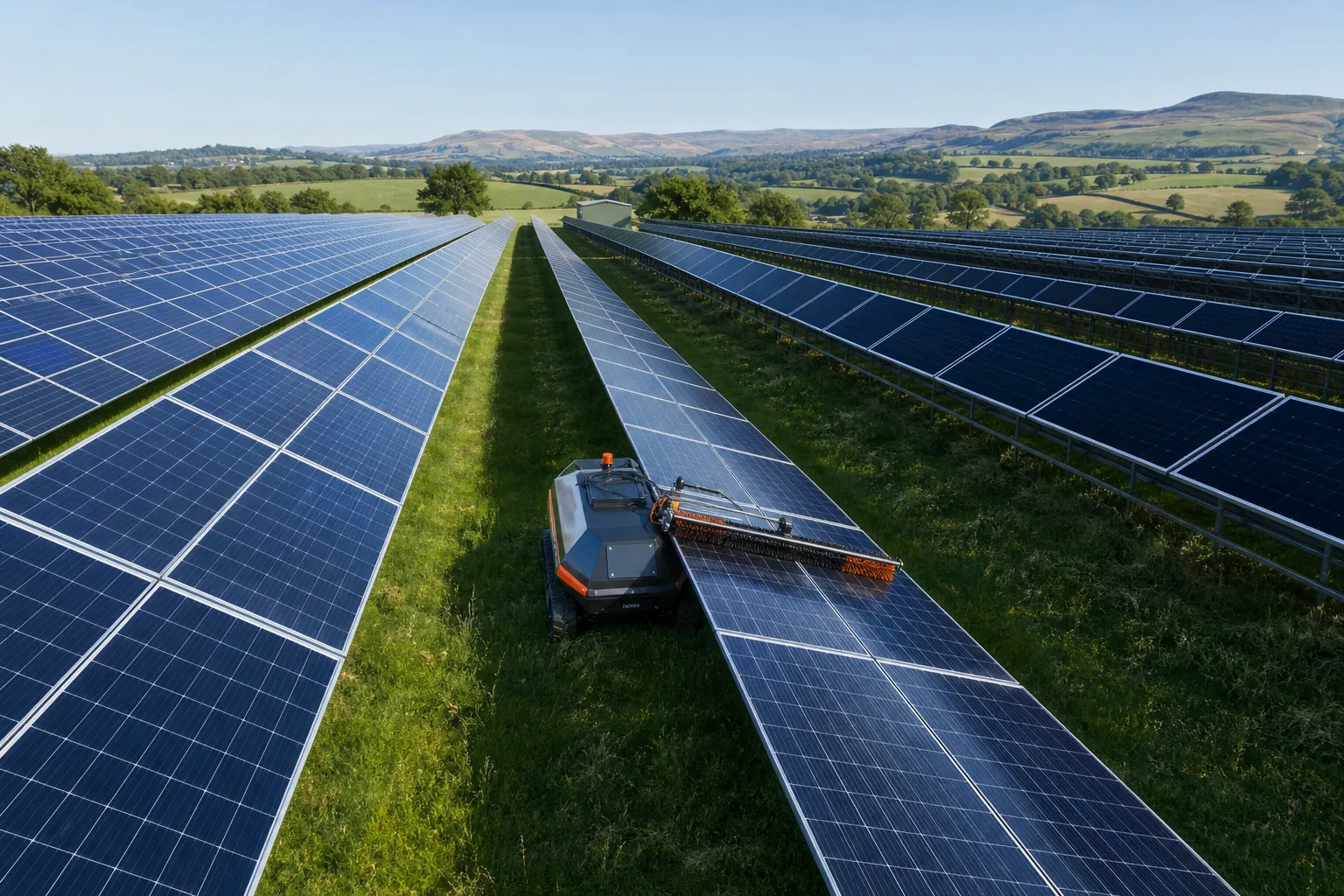
These machines travel over arrays, brush away dust and rinse panels without a human climbing the roof. They keep the glass clear so sunlight reaches the cells, which helps the array stay closer to its expected output. Coverage varies depending on slope and soiling level.
Because they run on rechargeable batteries, most models can operate for several hours before auto‑docking for a top‑up. Some units carry a small solar panel of their own to recharge between runs.
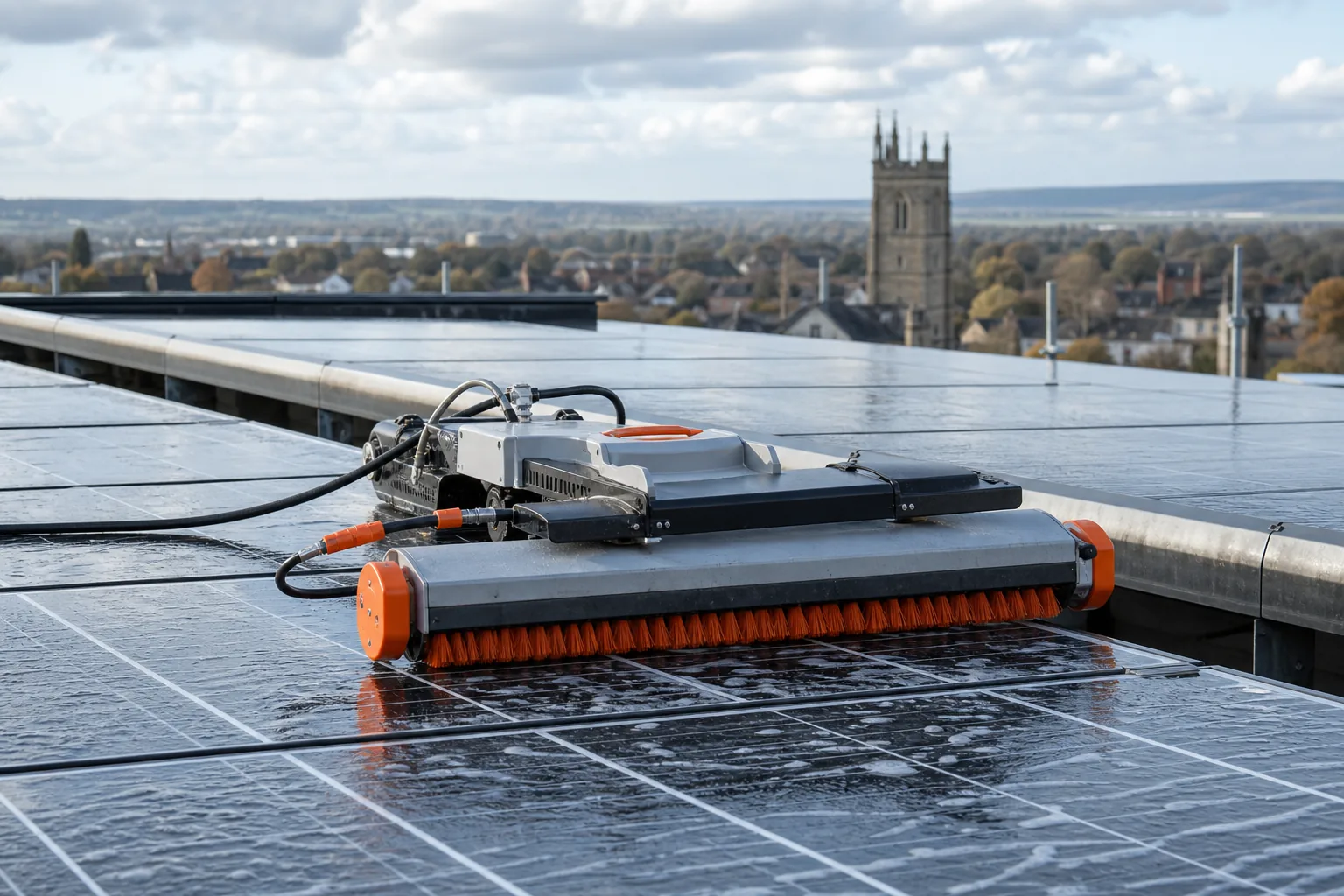
Robots are most useful where manual cleaning is costly or unsafe, for example, on utility‑scale farms, high‑rise commercial rooftops, or farms with dust‑rich soils. In those settings the labour savings often outweigh the capital spend.
A drone-based thermography survey can identify a dirty panel, after which a robot may be dispatched to clean that exact row, saving time and reducing climb‑risk. Solar Panel Cleaning: 7 Essential Tips
How the Cleaning Mechanism and Controls Work
The brush head usually consists of soft, non‑abrasive fibres that roll across the glass. A counter‑rotating roller lifts dust, while a gentle water mist (or dry air stream) washes it away. The system is designed to avoid scratching the anti‑reflective coating.
Control logic lives in a small on‑board computer. Sensors detect panel tilt, edge proximity, and obstacles. When the robot reaches a gap, the wheels steer automatically to stay on track. A lidar or ultrasonic rangefinder feeds the controller so the unit can pause, reverse, or re‑align as needed.
Many robots support remote scheduling via a web dashboard. You set a cleaning window, the robot syncs to the site’s weather data, and it starts when the sun is high enough for solar‑recharging but low enough to avoid overheating the panels.
Safety interlocks stop the robot if wind speed exceeds a preset threshold, because high wind could lift the unit or damage the brush.
What Affects Cleaning Results and Energy Yield
Soiling type is the biggest driver. Dust from rural sites, pollen from nearby fields, and bird droppings each have different adhesion characteristics. Dry‑brush robots excel on fine dust, while water‑mist units handle sticky pollen better.
Climate matters too. UK rain washes off some surface dirt, but deposits can build up during dry spells or when agricultural dust blows onto panels.
Panel orientation also plays a role. Panels at a shallow tilt shed less dirt when it rains, so grime tends to build up faster on low-pitch roofs. Robots with self‑aligning wheels can adjust to different tilt angles, keeping contact consistent.
When you combine the robot’s cleaning efficiency with the site’s soiling profile, you can estimate a payback period. Base that estimate on your own measured soiling losses and energy prices rather than a generic figure.
Where Robots Fit on UK Commercial and Public Estates
The UK government has set an ambition of up to 70 GW of solar PV by 2035, and the installed base keeps growing. That growth adds to the maintenance workload, especially on large sites.
Utility‑scale farms are a market for intelligent cleaning robots. The economics of automation can work well at that size. Prices depend on the model and its level of autonomy, and some suppliers add an annual software licence, so ask for a full quote.
Commercial rooftops (factories, warehouses and retail parks) are another common setting. Here, water‑less robots can suit roofs where getting a water supply up to the array is awkward or costly.
Public estates such as schools, hospitals, and council buildings often have mixed‑size arrays. For them, a modular robot that can be swapped between dry and wet modes offers flexibility. Our own drone surveys for Visual Perspectives help asset managers decide if a robot is the right fit by mapping soiling patterns across the whole campus.
When a local authority pilots a robot on a council‑owned solar roof, the project typically involves an O&M contractor that purchases the unit, a system integrator that handles software localisation, and the estate manager who signs off on the safety case.
In short, a robot is most likely to pay off on large arrays, or where soiling is heavy and safe access is costly. Top Solar Panel Inspection Equipment
Cleaning Is Not the Same as Solar PV Inspection
Cleaning removes visible debris; inspection looks for hidden defects. A robot can’t spot cracked cells, loose connectors, or hot‑spotting caused by bypass‑diode failure.
A sensible approach pairs cleaning with a drone‑based thermal survey carried out to IEC 62446‑3. The infrared camera catches temperature anomalies that indicate cell damage or connection issues, problems a brush can’t fix.
To check whether cleaning actually improved performance, compare monitoring data from similar periods before and after the clean.
For compliance, many warranties require documented maintenance records. Many robots log each cleaning run, and those records can be attached to the inspection report for audit purposes.
So while a robot keeps panels bright, you still need a qualified surveyor to confirm the electrical health of the system. Best Way to Clean Solar Panels on Commercial Roofs
Frequently Asked Questions
Do solar panel cleaning robots work in wet UK weather?
Many are built for outdoor use. Check the unit’s IP rating for rain and dust protection, and ask the supplier how it behaves in heavy rain.
How much water does a water‑less robot use?
None. Dry‑brush systems rely on a soft fibre roll and a small air‑blast, so they avoid water use altogether, which helps on roofs without a convenient water supply.
What is the typical payback time for a robot on a 1 MW site?
There is no reliable typical figure. Payback depends on your measured soiling loss, electricity price, labour costs and the robot’s upfront price, so ask the supplier to model it with your own site data.
Can a robot clean tilted panels on a steep roof?
Some can, within the slope limit the manufacturer states. Beyond that, safety guidelines often require human access.
Do robots replace the need for regular inspections?
No. Robots keep panels clean, but they can’t detect electrical faults or structural issues. You still need periodic inspection, such as a drone‑based thermographic survey carried out to IEC 62446‑3.
Are there any regulatory approvals needed?
In the UK, check that the robot carries UKCA or CE marking. Employers also need a suitable risk assessment for installing and maintaining it on a roof, under the Management of Health and Safety at Work Regulations 1999.
Conclusion
Solar panel cleaning robots make the most sense for large, high‑soiling installations where labour and safety costs are high. If your estate fits that profile, let us run a drone‑based thermography survey and work out whether a robot‑cleaning programme would give you a solid ROI.
Visual Perspectives Limited provides independent thermal imaging and drone inspection services throughout the UK.