Commercial solar panels on rooftops can lose up to 5% of output each year if you miss a small fault. That loss adds up fast for big estates. In this guide you’ll get the resources you need to keep large PV arrays humming , from standards you must follow, to the latest drone thermography tricks, to a ready‑to‑use inspection checklist. We’ll also show you how to pick the right provider and share real‑world case studies so you can act today.
Key Industry Standards for Commercial Solar Panel Inspection
When you inspect a commercial rooftop PV system you need a framework that everyone trusts. In the UK the go‑to reference is IEC 62446‑3. The standard spells out how to do thermal imaging, string‑level testing, and reporting so that owners, insurers, and O&M teams all speak the same language. It tells you to capture geotagged thermal images, log the exact time of each pass, and grade faults by severity. The result is a report that can be handed to the installer or the finance team without any guesswork.
Another key piece is the Building Regulations Approved Document Part L, which covers the energy performance of new and existing buildings. It requires that any solar installation on a commercial roof does not compromise fire safety or structural integrity. The document also forces a regular inspection cadence , typically every two years , and mandates that any detected defect be documented in a certified report.
On top of the IEC and Building Regs you’ll often see the MCS (Microgeneration Certification Scheme) cited. While MCS is mostly about eligibility for the Smart Export Guarantee, it also demands that the installer keep a record of panel performance and that a qualified professional conducts any major inspection. This extra layer protects you from low‑quality work and gives lenders confidence when they finance a project.
All three standards work together. IEC 62446 gives the technical method, the Building Regs set the safety envelope, and MCS adds the financial and warranty guardrails. When a report ticks each box you can be sure the data is reliable and that the risk of hidden faults is low.
Because compliance matters, we always match our drone flights to the IEC timing rules , at least 600 W/m² solar irradiance and low wind , so the thermal data meets the standard’s accuracy thresholds.
Bottom line: Follow IEC 62446‑3, Building Regs Part L, and MCS to get a legally sound, financially safe, and technically accurate inspection.
The Role of Drone Thermography in Solar Panel Diagnostics
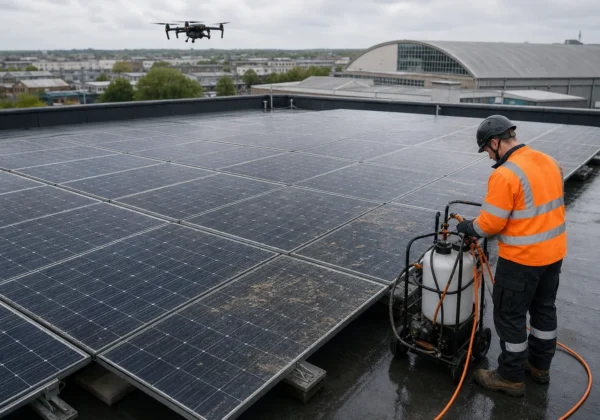
Drone thermography has changed the way large PV farms stay healthy. A single drone can fly over 100 MW of panels in a day, capture radiometric thermal images, and feed them into AI models that spot hotspots, cell cracks, and PID. Those models tag each defect with GPS coordinates, so a technician can walk straight to the exact panel that needs attention.
, equipment‑driven underperformance cost the industry $10 billion in lost revenue. The same report notes that manual inspections only cover 1‑2 MW per day, meaning a 100 MW site would take months to check , and by then the first panels could have changed temperature, hiding the real issue.
Thermal cameras on drones, like the DJI Zenmuse H30T, have a resolution of 1280×1024 pixels and a sensitivity under 50 mK. That level lets you see temperature differences as small as 1 °C, which is enough to catch a hotspot that’s 30 °C above the surrounding panel , the safety‑critical threshold many O&M contracts use.
But thermography alone isn’t enough. The IEC 62446‑3 standard says you also need string‑level electrical testing when you want to confirm a diode failure or an insulation resistance issue. Combining the two gives you a full picture: heat tells you where something is wrong, the string test tells you why.
When you add AI, the speed jump is even bigger. A trained model can classify each panel in under a second, rank defects by severity, and generate a work order list automatically. That means you spend less time writing reports and more time fixing real problems.
In practice, a UK‑based solar operator used a drone‑thermal‑AI workflow on a 5 MW rooftop array. They cut inspection time from three days to six hours and found three hidden hotspots that would have caused a 2% loss in output each year. Those savings add up to over £100 k in the first year alone.
Bottom line: Drone thermography plus AI gives you fast, accurate, and actionable defect data that manual checks can’t match.
Essential Inspection Checklist for Commercial Rooftop PV Arrays
Having a checklist keeps your inspection crew on track and ensures no detail slips through. Below is a step‑by‑step list that matches IEC 62446‑3 and the UK Building Regs. You can download a printable version from our site, but here’s the core of it.
1. Pre‑flight Planning
- Confirm weather: clear sky, irradiance ≥600 W/m², wind <5 m/s.
- Load the latest GIS layer of the roof and mark panel strings.
- Check drone CAA permissions , we operate under an Enhanced Operating Safety Case that lets us fly as close as 10 m to nearby structures.
2. Thermal Capture
- Fly at a 45° angle to reduce reflection.
- Collect overlapping thermal passes for 100% coverage.
- Geotag every image; the IEC requires timestamps for each frame.
3. RGB Capture (optional but recommended)
- Capture sub‑centimetre GSD orthomosaic for visual context.
- Mark any visible soiling, bird droppings, or broken glass.
- Link each RGB tile to its thermal counterpart.
4. String‑Level Electrical Test (if selected)
- Measure voltage, current, and insulation resistance for each string.
- Plot I‑V curves and compare against manufacturer specs.
- Flag any string that deviates >5% from expected performance.
5. Data Review & Fault Grading
- Use the IEC colour code: red for safety‑critical, orange for high impact, yellow for moderate, green for minor.
- Prioritise fixes that exceed a 30 °C differential hotspot.
- Attach a clear photo and location tag to each fault.
6. Reporting
- Generate a PDF that follows IEC 62446‑3 layout , executive summary, fault map, detailed tables, and recommended actions.
- Include a risk matrix that maps each fault to potential financial loss.
- Deliver the report to the asset manager, installer, and insurance broker.
We use this exact flow for every commercial job we do, and it means you never have to wonder if something was missed. The process is “quickly, precise, and detailed” , the three words we tell every client.
Bottom line: A solid checklist turns a complex inspection into a repeatable, compliant workflow.
How to Choose a Certified Solar Panel Inspection Provider
Picking the right provider is more than looking at price. You need to verify three things: compliance, data quality, and risk protection.
Compliance, The provider must deliver IEC 62446‑3 reports and be able to show proof of CAA‑approved operating permissions. Ask for their latest certificate and check that it’s valid for commercial rooftop work.
Data Quality, Look for providers that combine thermal IR with high‑resolution 3D mapping. Drone Media Imaging, for example, offers “high‑accuracy radiometric” thermal data plus 3‑D orthomosaics, while some competitors only give raw thermal pictures. The extra 3‑D layer helps you see panel tilt, shading, and roof penetrations in a GIS‑ready format.
Risk Protection, Insurance matters. Many UK firms hide their liability limits, but the standard for commercial work is at least £5 M public liability. Visual Perspectives openly states a £5 M cover, giving you peace of mind if a drone mishap occurs.
Another red flag is transparency on pricing. The research hook shows that top providers often hide cost details, making budgeting hard. Ask for a clear quote that breaks down flight time, data processing, and reporting fees.
Finally, check the provider’s track record. A solid portfolio of commercial case studies , like schools, hospitals, or large office blocks , shows they can handle the scale you need.
When you line up these criteria you’ll see that Visual Perspectives ticks every box: we hold CAA Category 2 thermographer qualifications, we ship IEC‑compliant reports, we map roofs in 3‑D, and we carry £5 M insurance.
Bottom line: Choose a provider that is IEC‑compliant, offers 3‑D data, and shows clear insurance and pricing , that’s how you cut risk and get reliable results.
Real‑World Benefits: Case Studies in Commercial Solar Panel Inspection
Numbers help, but real stories stick. Below are three anonymised examples that show what a proper inspection can achieve.
Case 1 , University Campus
A UK university had a 2 MW rooftop array installed in 2015. The O&M team ran a manual check every year, which cost £12 k and missed a small hotspot on a south‑west corner. Visual Perspectives flew a drone in June 2025, found three hotspots, and flagged a broken diode that was causing a 1.2% loss. The university fixed the diode, saved roughly £15 k in lost revenue, and avoided a potential fire risk.
Case 2 , Hospital Trust
A large NHS trust ran an IEC‑compliant inspection on a 3.5 MW roof. The thermal data showed an area of high temperature that matched a roof penetrations issue , water was getting into the panel junction box. The trust repaired the roof seal, preventing moisture‑related corrosion that could have cost over £200 k in panel replacements.
Case 3 , Logistics Hub
A logistics company with a 4 MW rooftop farm used a competitor that only offered thermal images. They missed a series of micro‑cracks that later caused PID, cutting output by 8% over two years. After switching to a provider that also gave 3‑D mapping and string‑level testing, they caught the cracks early, re‑matched the strings, and restored 95% of the lost output , a gain of about £120 k per year.
“The first time we saw a hotspot with a drone, we knew we could stop a fire before it started,” says a senior facilities manager at the hospital.
All three cases share a pattern: a fast, compliant drone inspection finds hidden faults, saves money, and reduces safety risk. The extra data layers , 3‑D maps, GIS tags, and string‑level electrical results , let the owners plan repairs in a logical order instead of guessing.
Bottom line: Real‑world projects show that a proper inspection can protect people, boost output, and save big bucks.
Frequently Asked Questions
What is IEC 62446‑3 and why does it matter for commercial roofs?
IEC 62446‑3 is an international standard that defines how to test, document, and maintain grid‑connected PV systems. It sets the rules for thermal imaging, string‑level electrical testing, and report formatting. When a provider follows it, you get data that regulators, insurers, and investors all trust. It also means the inspection can be used for warranty claims and O&M contracts without extra paperwork.
How often should a commercial PV array be inspected?
Most owners schedule a full IEC‑compliant inspection every two years. If the site has a high‑risk environment , like a coastal location with salt mist , you may want an annual check. The key is to inspect when the panels are under full load, typically between May and September, so the thermal signatures are clear.
Can drones inspect flat roofs as well as sloped ones?
Yes. Modern UAVs can hover low and follow a grid pattern over flat roofs. The same thermal cameras work, and the 3‑D mapping helps you see any hidden panels behind parapet walls. Flat roofs often have drainage traps that can cause panel shading, so a drone is especially useful there.
What equipment does Visual Perspectives use for thermography?
We fly drones equipped with radiometric thermal cameras such as the DJI Zenmuse H30T, which offers 1280×1024 resolution and sub‑50 mK sensitivity. The cameras are calibrated daily, and our pilots hold Category 2 thermographer qualifications, ensuring the data meets IEC 62446‑3 accuracy requirements.
Do I need to shut down the solar array for an inspection?
No. The inspection is non‑intrusive and done while the panels run at full output. The only time you may need a short shutdown is if you request a string‑level electrical test that requires disconnecting the inverter, but even that can be done from ground level without climbing on the roof.
How does drone thermography compare to manual handheld thermal checks?
Drone surveys cover up to 100 MW per day, while a technician with a handheld camera can only check 1‑2 MW in the same time. Drones also give you GPS‑tagged images and can capture the entire roof in a single flight, reducing human error and safety risk. The result is faster, safer, and often cheaper overall.
What should I look for in the final inspection report?
Make sure the report follows IEC 62446‑3 layout: an executive summary, a fault map with colour coding, detailed tables of thermal readings, and a clear list of recommended actions. It should also include GIS‑ready data files if you need to import the faults into a building information model.
Is there a way to integrate the inspection data with my existing asset management software?
Yes. Most providers, including Visual Perspectives, deliver the data in standard formats like CSV, shapefile, and IFC. Those files import straight into most FM software, letting you track faults, schedule repairs, and run cost‑benefit analysis automatically.
Conclusion
Keeping a commercial solar array at peak performance is a mix of good standards, the right technology, and a trustworthy partner. IEC 62446‑3, Building Regs Part L, and MCS give you the rulebook. Drone thermography and AI give you speed and precision. A solid checklist turns a complex job into a repeatable process. And a provider that is transparent on insurance, pricing, and data quality , like Visual Perspectives , makes the whole thing safe and easy.
If you’re ready to lock in compliance, cut down risk, and boost output, start by booking a free, no‑obligation drone inspection with us. We’ll run the flight, give you an IEC‑ready report, and show you the exact next steps to keep your roof humming.