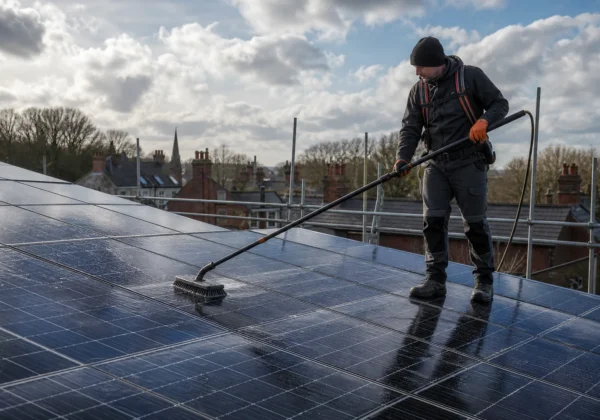
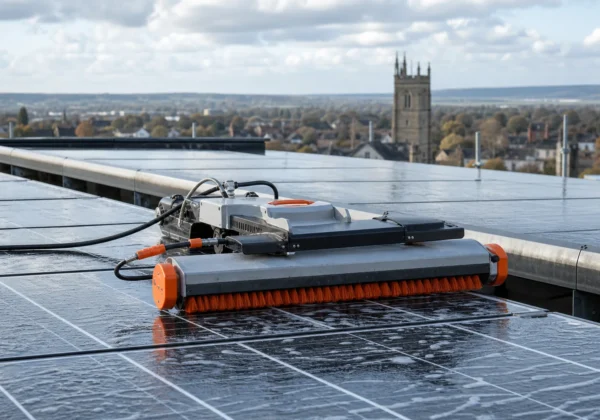
A solar farm’s output can drop overnight, and a quick thermal scan can find out why before you lose serious revenue. So what does a commercial solar PV thermography inspection cost in the UK, and who should you actually call? Disclosed base prices sit around £400 to £600, but most providers quote on request. Here are the top providers worth your shortlist, what each one does best, and the honest caveats.
We cover drone-first specialists, ground-based handheld firms, IEC 62446 compliance experts, and pre-installation roof survey teams, so you can match the right inspection to your rooftop array.
1. Visual Perspectives Limited (Our Top Pick)
Visual Perspectives Limited provides managed drone-based aerial inspections across the United Kingdom, with thermographic surveys of solar PV systems on commercial roofs and public buildings. We pair high-resolution thermal imaging with high-resolution 3D mapping, and our reporting is compliant with IEC 62446 standards.
This pick is best for property asset managers, facilities managers, solar installers, and insurers who need a verifiable, standards-based report quickly. In a market where most providers stay quiet on compliance, we openly work to IEC 62446, the international standard for testing and documenting grid-connected PV systems.
Why it earns the top spot comes down to credentials and added insight. We hold ITC Level 1 and 2 thermography qualifications, fly CAA-compliant operations, and carry £5,000,000 insurance, backed by 20 years of experience. The 3D mapping is the part rivals skip. It pins each thermal fault to an exact spot on the roof, so your maintenance team can find a faulty module or bypass diode fast, without searching rows by hand. You’ll get accurate defect diagnostics and actionable reporting, not just a folder of images.
If you want to understand how the survey, analysis, and reporting fit together before you book, our guide on IEC 62446 commercial solar PV thermography services walks through the compliance side in plain terms.
One honest caveat: like most commercial providers, our rooftop pricing is by quotation because site size, layout, and access vary so much. You’ll get a clear figure once we’ve seen the array. Rest assured you’ll be in good hands, with data that holds up for insurers and electricians alike.
2. Drone-Based Aerial Thermography , Fast, Scaffold-Free Surveys
Drone-based aerial thermography providers fly thermal cameras over your panels instead of putting people on the roof. For commercial rooftop PV and large arrays, this is the fastest, lowest-risk way to scan every module without scaffolding or access equipment.
This category suits energy managers and O&M teams who need to cover thousands of panels in a single visit. The speed is the headline: inspecting a large array by hand can take hours, while a drone does it in a fraction of the time.
Modern drone platforms carry combined visual and thermal sensors that flag hotspots, faulty cells, and physical damage at scale. High-resolution thermal sensors capture temperature variations across an array, then feed software that can diagnose anomalies with high accuracy. The panels stay live during the flight, so there’s no plant downtime and no lost generation.
The catch is data quality depends on conditions. You need clear, stable sunlight and decent irradiance for accurate thermal readings, so weather and season affect both scheduling and price. Wind can create a cooling effect that masks a faulty panel. If you want the mechanics broken down further, our explainer on drone thermography for commercial roofs covers how the imaging actually works.
A decision rule: if your site is large or hard to access, drone-first almost always wins on speed and cost per panel.
3. Ground-Based Handheld Thermography , Detailed String-Level Diagnostics
Ground-based handheld thermography sends a certified technician to walk the array with a thermal camera, panel by panel. It’s slower than a drone, but it gives close, deliberate diagnostics where access allows.
This option fits smaller commercial roofs, plant rooms, or jobs where you need string-level electrical testing alongside the thermal pass. Many handheld surveys pair infrared imaging with electrical checks like voltage, current, insulation resistance, and I-V curve performance, all at ground level without rooftop access.
The strongest providers in this category work to recognised standards. Some use high-resolution infrared cameras of at least 640×480 resolution, the threshold set out in IEC 62446-3:2017 for compliant inspections. That matters because controlled conditions and certified equipment stop false readings and misdiagnosed faults. Reports come geotagged with anomaly classifications and recommended next steps.
Handheld inspection has clear limits at scale. Walking every panel on a multi-megawatt site takes days, and access to the roof itself can mean working at height or hiring lift equipment. For large rooftop arrays, the labour cost climbs fast. If you’re weighing methods side by side, our overview of solar panel thermal inspection methods for commercial buildings”>solar panel thermal inspection methods compares the trade-offs. Handheld works best as a focused tool: targeted verification, smaller sites, or a deeper electrical look at a string the drone flagged.
4. IEC 62446 Compliance & Insurance-Focused Inspection
IEC 62446 compliance and insurance-focused inspection exists for one reason: to give your insurer and your electrician documented evidence they both accept. If an auditor has asked you to prove your array is safe and maintained, this is the category you want.
This work produces certified reports under IEC 62446-3:2017 for thermography and IEC 62446-1 for electrical string testing, often in a single site visit. The standard sets the methodology for testing and documenting grid-connected PV systems, including controlled environmental conditions and certified personnel.
The combined approach catches what a single discipline misses. Thermography finds cell and module heat faults. String testing surfaces wiring problems that throw no thermal signature at all, like a mismatched post-commission string creating reverse current risk. That kind of hidden electrical concern can surface on an ageing commercial rooftop during an insurance-driven survey, well beyond the original brief. A single certified document strengthens the owner’s position with both insurers and any future contractor.
The honest limitation: this depth costs more and takes longer than a quick thermal-only scan. You’re paying for higher-level sign-off and a defensible paper trail. For commercial owners, that trade is usually worth it, since solar fires and degraded modules are the risks insurers care about most. Our resource on solar panel warranty inspection for commercial buildings explains how the same reports protect warranty claims too.
5. Pre-Installation Roof Condition Surveys , Defect Detection Before Solar PV
A pre-installation roof condition survey inspects the roof itself before any panels go on. It’s the step too many projects skip, and it’s where thermography quietly saves the most money on a commercial rooftop PV array.
This is for project managers, building surveyors, and installers about to mount solar on an existing flat or pitched roof. A thermal survey finds hidden defects under the membrane, like trapped moisture and saturation, that you can’t see with the naked eye. Put panels over a saturated roof and you’ve buried a leak under thousands of pounds of array.
Timing makes the data. Roofing membranes absorb heat from the sun during the day and release it after sunset, while water penetration holds and offgasses heat at a different rate. So moisture issues show up far more clearly in a post-sunset thermal scan than at midday. A daytime visual pass alongside it confirms whether a cool corner is wet roof or just shade from nearby trees.
The caveat is sequencing. A pre-install survey only helps if you commission it before the racking goes down, because once panels are fixed, re-roofing means lifting the whole system. Build the survey into your project timeline early. For the full process, our guide on how drone roof inspection works for commercial buildings covers what to check before installation begins.
What Drives the Cost: Comparing Inspection Options
Commercial solar PV thermography inspection cost in the UK comes down to a few levers: site size, drone versus handheld method, depth of analysis, compliance level, and travel. Disclosed base prices in the market cluster around £400 to £600, averaging near £500, but most commercial rooftop work is quote-on-request because no two arrays are the same.
Here’s how the main options stack up on the decisions that affect your budget and your report.
One transparency note worth knowing: only some UK providers publish base prices at all, and just one rival in our comparison advertises a turnaround time, promising results within 72 hours. If fast reporting matters to your asset team, ask about it up front. For a fuller breakdown of pricing factors, our guide on drone roof inspection cost in the UK shows how the numbers come together.
Frequently Asked Questions
How much does a commercial solar PV thermography inspection cost in the UK?
Disclosed UK base prices sit around £400 to £600, with an average near £500, though most commercial rooftop arrays are priced by quotation. Final cost depends on site size, the drone or handheld method, analysis depth, compliance level, and travel. Larger or multi-megawatt sites cost more because they need more flight time and detailed reporting.
What is IEC 62446 and why does it matter for solar inspections?
IEC 62446 is the international standard for testing, documenting, and maintaining grid-connected photovoltaic systems. It matters because it sets controlled conditions, certified thermographers, and calibrated equipment that prevent false readings. Insurers and warranty providers often want IEC 62446-compliant reports as proof your array is safe and properly maintained, which protects your coverage and your investment.
Is drone thermography better than handheld for commercial roofs?
Drone thermography is usually better for large commercial rooftops because it scans every panel in minutes without scaffolding or roof access. Handheld inspection suits smaller sites or targeted string-level checks where a technician needs a close look. Many projects use drone surveys first to flag faults, then handheld or electrical testing to verify specific anomalies.
Why should I survey my roof before installing solar panels?
A pre-installation thermal survey finds hidden defects like under-membrane saturation and trapped moisture before panels go on. Once an array is fixed in place, fixing a leaking roof means lifting the whole system at high cost. A post-sunset thermal scan reveals wet roof areas the naked eye misses, so you fix problems while the roof is still clear.
How long does a commercial solar PV inspection take?
A drone thermal survey can cover thousands of panels in a single day, with the flight itself taking minutes ing timelines vary, but one UK provider advertises results within 72 hours. Combined thermographic and electrical string testing on a complex multi-pitch site is typically done in one coordinated visit, with the certified report following afterwards.
Conclusion
For commercial rooftops that need a fast, standards-based report you can hand to an insurer, Visual Perspectives Limited is the provider to call first, because we openly work to IEC 62446 and add 3D fault mapping that rivals skip. The next step is simple: get a quote for your specific array so the price reflects your real site, then book the survey inside your maintenance or project schedule before peak season fills up.