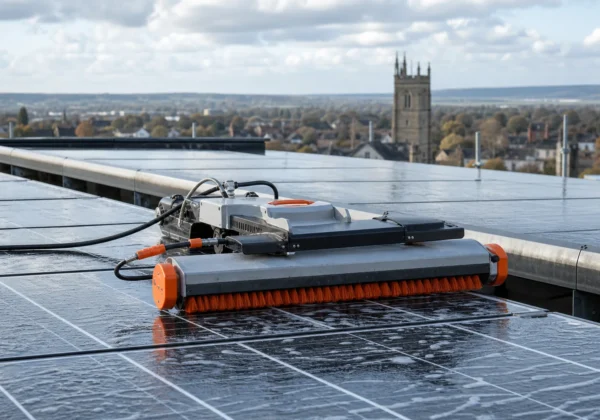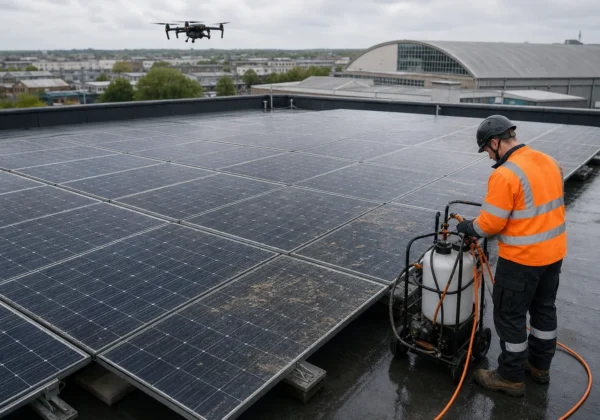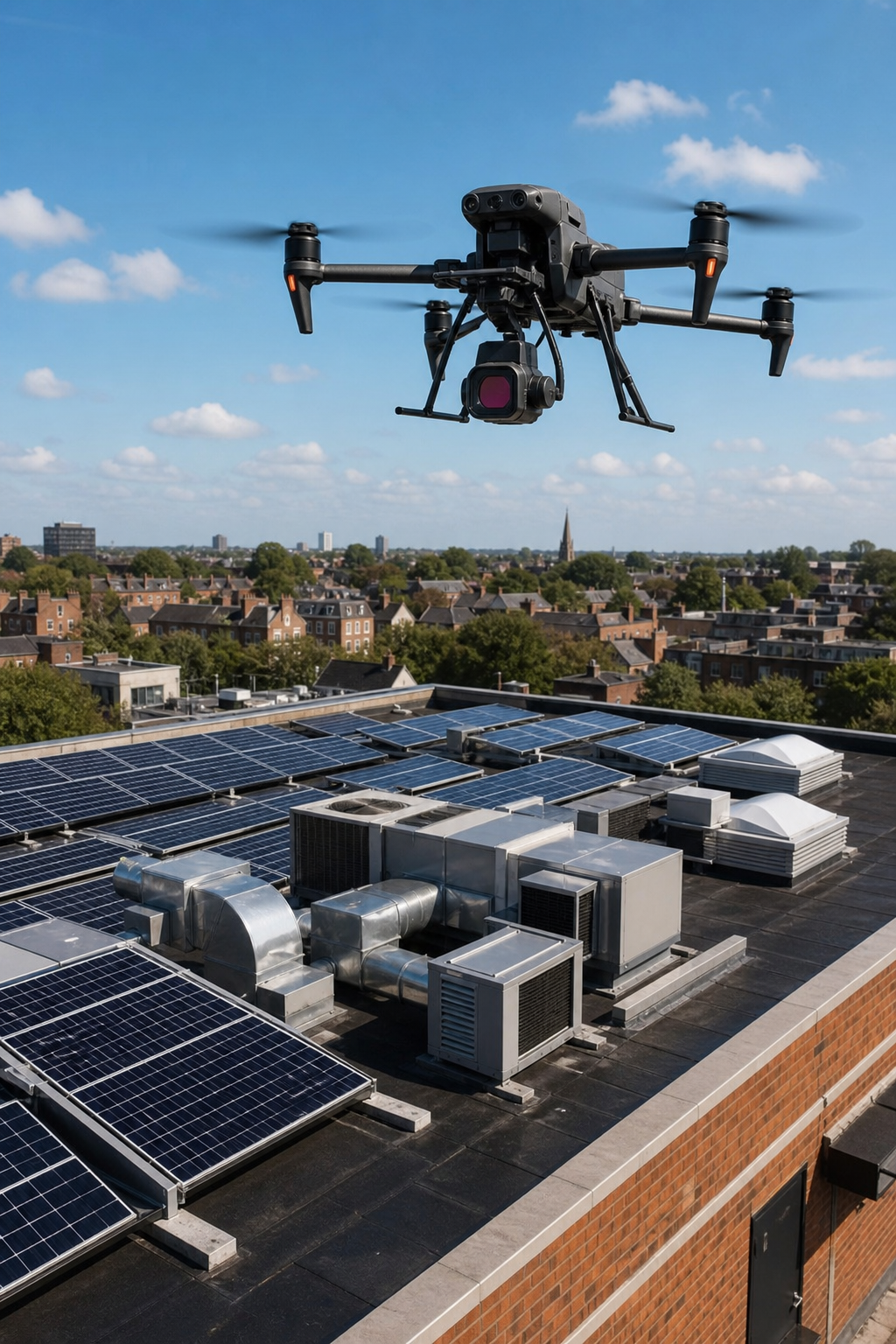
Ever wondered how you can scan an entire commercial roof in minutes without ever stepping on a ladder? It’s not a dream. It’s what professional drone roof survey services do every day across the UK. In this guide, we’ll walk you through 11 essential drone roof survey services that property managers, building surveyors, and solar installers rely on. You’ll learn which service fits your next project , and why the right partner makes all the difference.
1. Visual Perspectives , Expert Drone Roof Surveys for UK Commercial Buildings
Visual Perspectives provides managed drone-based aerial inspections across the UK. We specialise in roof and façade surveys for commercial and public buildings. Our team combines 20 years of experience with ITC Level 1 and 2 thermography qualifications and full CAA compliance. Every survey is backed by £5 million insurance.
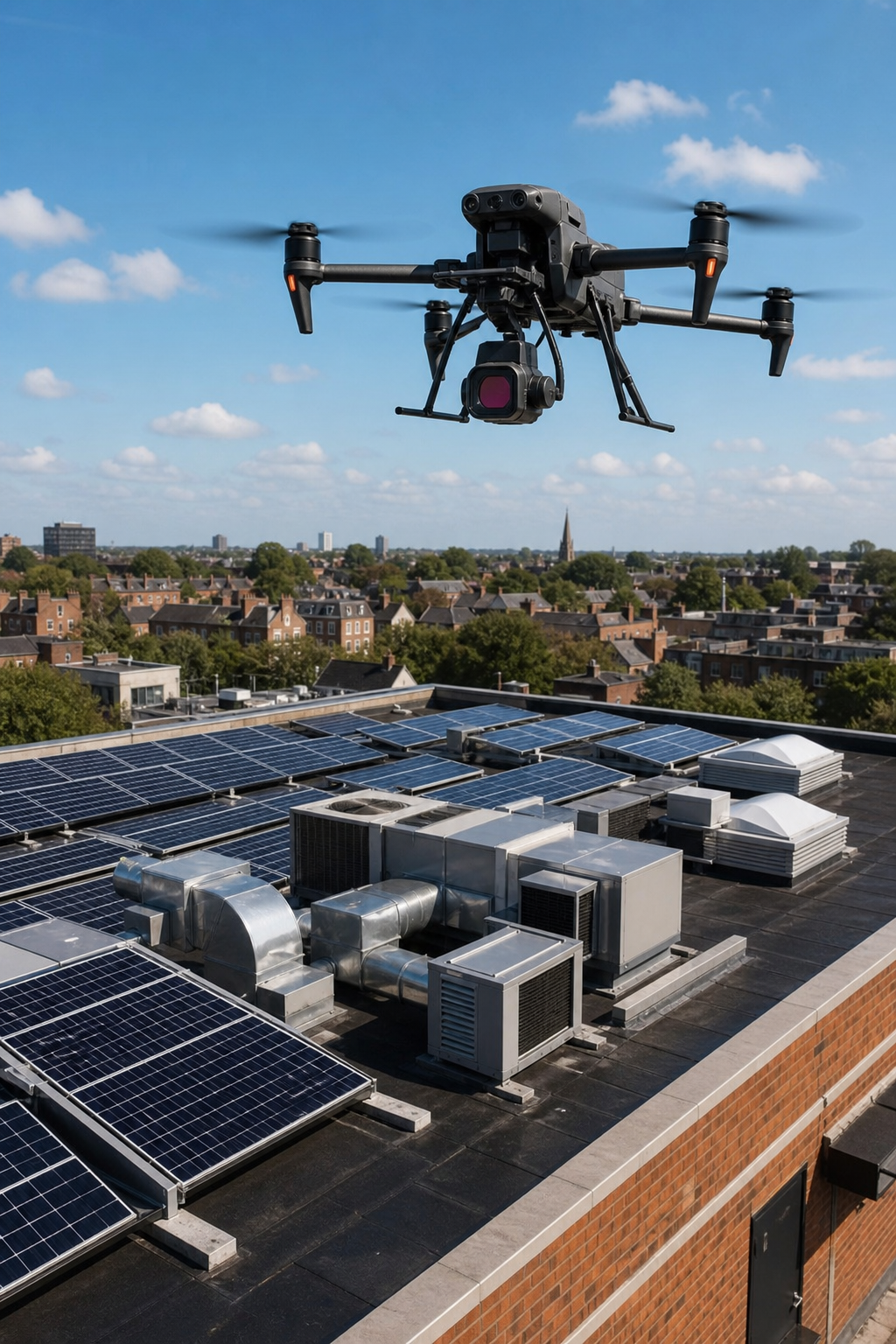
We don’t just fly drones. We deliver actionable reports that help you detect heat loss, identify flat roof defects, and support decarbonisation strategies. Our drone roof survey guide for commercial properties explains how we turn raw data into clear decisions.
What sets us apart? We follow IEC 62446 standards for solar PV thermography. We use radiometric thermal cameras to measure exact temperatures. And we produce high-resolution 3D maps and orthomosaics that integrate with your BIM or GIS workflows.
2. Solar PV Thermography & Inspection Services
Solar panels on commercial roofs need regular checks. A drone-based thermographic inspection reveals hot spots, cell failures, and bypass diode faults without any contact. This service is a must for any commercial rooftop PV array. According to IEC 62446(Wikipedia), the standard requires thorough documentation and thermal imaging for grid-connected systems. Using a drone makes the process faster and safer than manual inspections.
With a thermal camera, you can spot temperature differences as small as 0.1°C. That’s how you find defective panels before they cause energy losses or even fires. Our drone thermal imaging guide for commercial buildings shows how we combine visual and thermal data to give you a complete picture.
We recommend scheduling inspections after a clear day when modules are hot. That’s when defects show up best. Our reports include temperature measurements, defect locations, and severity ratings. No guesswork. You’ll know exactly what to fix.
3. Pre-Solar Installation Roof Defect Surveys
Before you install solar panels on a commercial roof, you need to know the roof’s condition. Hidden defects like under-membrane saturation can ruin a new installation. A pre-solar drone survey catches these issues early.
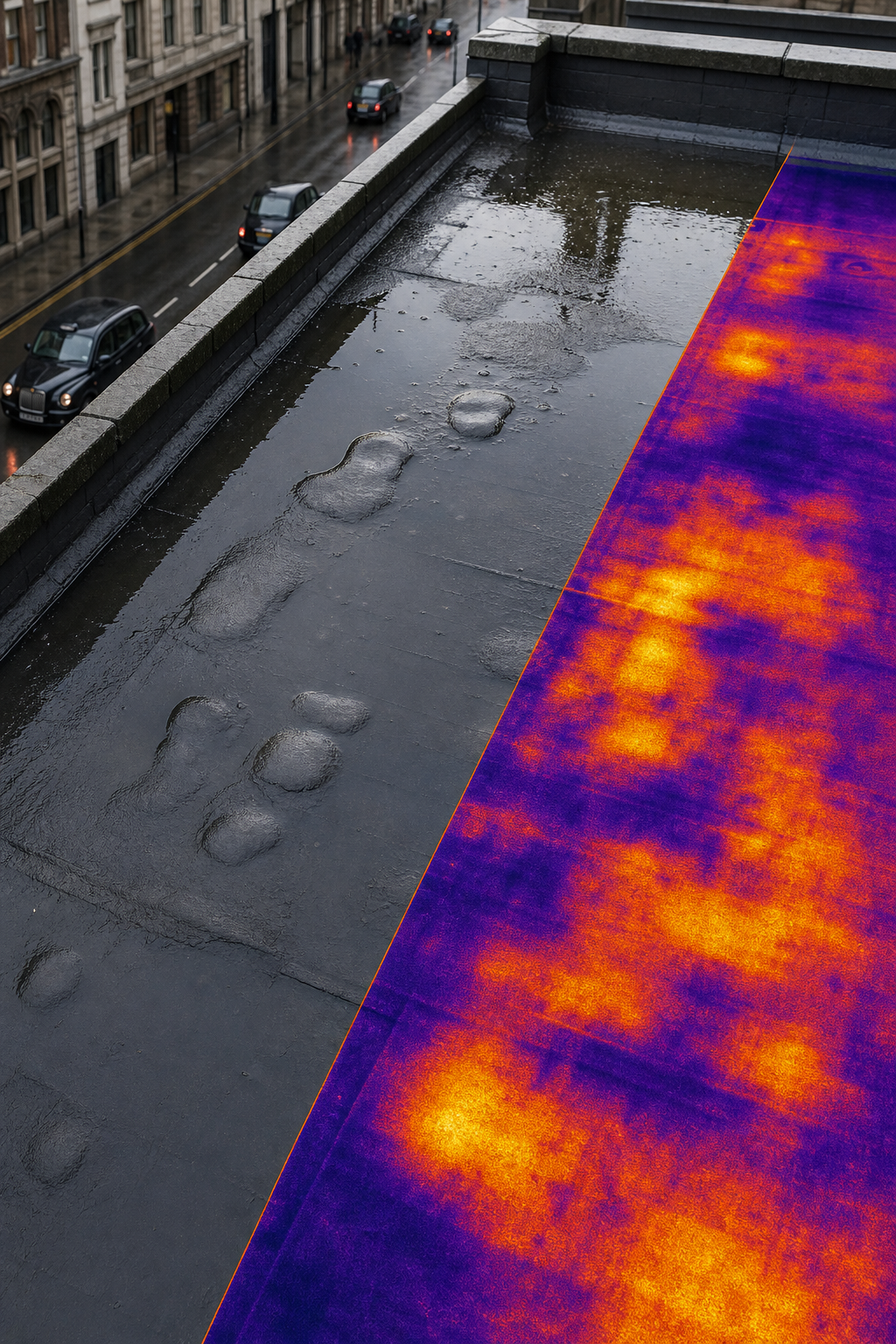
Why is this important? If you install panels on a roof with trapped moisture, the extra weight can cause collapse. The panels themselves might fail prematurely due to heat buildup from wet insulation. According to the UK’s Health and Safety Executive, falls from height remain the biggest killer on construction sites. Using a drone keeps your team safe while giving you a thorough assessment.
Our process is simple. We fly a double-grid pattern to capture every square metre. Then we analyse the thermal data to find cold spots , those are areas of saturation. We also take high-resolution RGB photos for visual defects like cracks, blisters, or ponding water. You’ll get a clear report before any installation begins.
This survey saves you thousands in potential repairs. Don’t skip it.
4. IEC 62446 Compliance Inspections for PV Systems
IEC 62446 is the international standard for grid-connected photovoltaic systems. It covers testing, documentation, and maintenance. If you own or manage a commercial solar array, you need to comply. Drone inspections make this easier.
We use high-resolution thermal cameras to capture every panel’s temperature profile. Our software then compares each module against the baseline. Any anomalies , like hot spots or string imbalances , are flagged and measured. The final report includes thermal images, temperature values, and a summary of non-compliant modules.
Why does this matter? Insurance companies and grid operators are increasingly requiring IEC 62446 documentation. Without it, you risk invalidating your warranty or facing penalties. Our thermal drone survey guide explains how we meet these requirements.
We also provide a clear action plan. Whether it’s a single faulty module or a systemic issue, you’ll know what to do next.
“Compliance isn’t just paperwork , it’s protection against solar fires and costly downtime.”
5. Drone Roof Inspection with Thermal Imaging for Flat Roofs
Flat roofs are prone to water ingress and saturated insulation. A thermal drone inspection finds these hidden problems fast. The principle is simple: during the day, the sun heats the roof. Any trapped moisture stays warm longer after sunset. A thermal camera flown after dark picks up those warm spots clearly.
We fly our thermal surveys about two hours after sunset. The roof has cooled, but moisture retains heat. That contrast reveals leaks that are invisible to the naked eye. We then overlay the thermal data onto a high-resolution RGB map. The result is a colour-coded moisture map that shows exact problem areas.
For large commercial buildings, this method is unbeatable. It covers thousands of square metres in a single night. No scaffolding. No ladders. No damage to the roof membrane. Our reports include annotated images, area measurements, and recommendations.
We’ve helped facilities managers at NHS Trusts and universities identify saturated insulation before it led to structural damage. Early detection saved them thousands in emergency repairs.
6. 3D Mapping and BIM Integration for Asset Management
Digital twins are transforming how buildings are managed. A drone roof survey can create a 3D model accurate to within centimetres. This model integrates with BIM (Building Information Modelling) systems, giving asset managers a real-time view of roof condition.
We use photogrammetry to stitch hundreds of overlapping images into a detailed 3D mesh. The model includes elevation data, so you can measure slopes, drainage paths, and clearances. Export formats like .rcs, .rcp, and .las make it easy to import into Revit or other BIM platforms.
Why does this matter? When you have a 3D model, you can plan repairs without sending a team to site. You can also track changes over time. Compare last year’s model with this year’s to see how fast a defect is growing.
This service is ideal for large portfolios , hospitals, university campuses, shopping centres. One model covers all your assets. It’s the smart way to manage maintenance.
7. Insurance-Compliant Roof Surveys and Documentation
Insurance claims after storms or accidents often require proof of roof condition. Drone surveys provide that proof. High-resolution images and thermal data document pre-existing damage and help adjusters assess new claims.
We produce reports that include date stamps, GPS coordinates, and temperature readings. This evidence holds up in disputes. If a claim is denied initially, our data can turn it around. We’ve seen cases where a drone survey revealed impact marks that the adjuster missed from the ground.
For underwriters, regular drone roof surveys reduce risk. They know the roof’s actual condition, not just a guess. This can lead to lower premiums or better terms.
We recommend annual inspections for all commercial properties. It’s the best way to catch problems early and keep your insurance team happy.
8. AI-Driven Defect Detection and Automated Reporting
Manual analysis of thousands of images is slow. AI changes that. Using machine learning models trained on thousands of roof defects, our software can identify ponding water, staining, corrosion, and missing components in minutes.
The AI scans every image, cross-references it with the 3D model, and marks each defect. It even measures the area affected. You get a report with numbered defects, photos, and locations. The whole process takes about 10 minutes, regardless of how many images you have.
But AI isn’t perfect. That’s why we always verify the results. Our thermographers review the AI output, remove false positives, and add context. The final report is both complete and accurate.
This service scales beautifully. Whether you have one roof or a hundred, AI ensures every defect is caught. It’s like having an extra inspector who never gets tired.
9. Drone Fleet Management for Large Commercial Portfolios
If you manage multiple properties, coordinating inspections can be a headache. We offer fleet management services that schedule, execute, and report on all your roofs in a single programme.
We assign a dedicated account manager who knows your portfolio. We use automated flight planning to ensure consistent coverage across every site. Data is delivered through a secure portal where you can view all reports, compare conditions over time, and export data for your own systems.
This approach saves money compared to hiring separate inspectors for each building. It also ensures consistency , one methodology, one reporting format, one point of contact.
We’ve managed estates with over 200 buildings for local councils and housing associations. The feedback is always the same: it simplifies maintenance planning and reduces emergency repairs.
10. Weather-Adaptive Flight Planning and Contingency Strategies
UK weather is unpredictable. A good drone survey service plans for it. We use professional weather forecasting tools to pick the best windows for thermal and visual flights.
For thermal surveys, we need a clear day followed by a cool evening. That’s rare in winter. So we book flexible slots and monitor forecasts daily. If conditions aren’t right, we reschedule at no extra cost. No point flying in rain or high wind , the data would be useless.
Our contingency plans include backup batteries, alternate flight paths, and even backup drones. We carry spares so a single fault doesn’t cancel the job. This reliability is why we’ve never missed a deadline for a major project.
We also brief clients on site-specific risks: nearby power lines, tree canopies, restricted airspace. Safety comes first, always.
11. Data Security and Privacy-Compliant Deliverables
When we fly over your property, we capture sensitive data. That’s why we take security seriously. All images and reports are stored on encrypted servers with access controls. You decide who sees what.
We comply with GDPR and the UK Data Protection Act. Your data is never shared with third parties without your consent. For sensitive sites like MOD buildings or NHS facilities, we offer additional security measures, including on-site data processing and secure transfer protocols.
Deliverables are provided through a password-protected portal. You can download reports, view them online, or share them with your team. Everything is logged for audit trails.
We also offer white-label options for businesses that want to present the data under their own brand. That’s a growing demand from surveyors who subcontract our services.
Comparison of Top Commercial Drone Roof Survey Services
Here’s a quick decision guide to help you choose the right service.
Note: Prices vary with roof size and location. Get a quote for your specific project.
Frequently Asked Questions
What is a commercial drone roof survey?
A commercial drone roof survey uses a drone equipped with high-resolution cameras and thermal sensors to inspect the roof of a commercial building. It captures data that reveals defects, moisture, heat loss, and structural issues. The data is processed into reports, 3D models, or thermal maps that help facilities managers make informed decisions about maintenance and repairs.
How much does a commercial drone roof survey cost?
Costs typically range from £400 to £2,500 depending on the size of the roof, complexity, and type of survey. For a single flat roof on a warehouse, expect around £500, £1,000. A full survey with thermal imaging, 3D mapping, and IEC 62446 compliance for a large office building can cost £1,500, £2,500. Always ask for a detailed quote upfront.
Do I need special permissions for drone roof surveys in the UK?
Yes. The Civil Aviation Authority (CAA) requires commercial drone pilots to hold an operational authorisation or be registered under the Open Category (for sub-250g drones). Most professional survey providers , like Visual Perspectives , already hold the necessary permissions and insurance. Always check that your provider is CAA-compliant before hiring.
Can drone surveys detect moisture in flat roofs?
Absolutely. Thermal imaging drones can detect trapped moisture beneath the roof membrane. The technique works best after sunset: moist areas retain heat longer than dry areas, creating a clear thermal contrast. This non-invasive method pinpoints leaks that are invisible to the naked eye, avoiding the need for costly exploratory openings.
What is IEC 62446 compliance?
IEC 62446 is the international standard for grid-connected photovoltaic systems. It specifies requirements for testing, documentation, and maintenance. For commercial solar arrays, compliance means having thermal imaging records, string current measurements, and a documented inspection schedule. Drone surveys make meeting these requirements efficient and thorough.
How long does a drone roof survey take?
Flight time is usually 20, 60 minutes for a single commercial building, depending on size and complexity. Add another 1, 2 days for data processing and report generation. For large portfolios, we can schedule multiple flights per night if weather allows. Total turnaround is typically 3, 5 business days from flight to delivered report.
Do drone roof surveys work in bad weather?
Thermal surveys need dry conditions and a clear day followed by a cool evening. Rain, heavy wind, or fog can delay flights. Professional providers monitor forecasts and have contingency plans. They’ll reschedule if conditions aren’t safe. Visual surveys (without thermal) can be done in light cloud cover, but not in rain.
Can drone survey data be used for insurance claims?
Yes, and it’s becoming standard. High-resolution images, thermal data, and 3D models provide objective evidence of roof condition before and after an event. Many insurance adjusters now prefer drone surveys over manual inspections because they offer a complete record. Our reports include date stamps and GPS data to support claims.
Conclusion
Commercial drone roof surveys are no longer a novelty , they’re a usable tool for any building owner or manager. They save time, reduce risk, and deliver data that manual inspections can’t match. Whether you need a pre-solar defect check, IEC 62446 compliance, or a simple condition report, there’s a service that fits.
At Visual Perspectives, we’ve been doing this for over 20 years. We know what it takes to get accurate, actionable results. Our team holds ITC thermography qualifications, CAA permissions, and £5 million insurance. We follow IEC 62446 standards and use the latest drones and sensors.
If you’re planning a commercial roof survey, get in touch. We’d be happy to discuss your project and provide a no-obligation quote. You’ll be in good hands.